The 2026 Web Development Revolution: A Comprehensive Guide to Mastering the New Digital Era
Introduction: The Death of Traditional Coding
Welcome to mid-2026. If you are still looking at web development through the lens of 2022 or 2024, you are already behind. The industry has shifted from "writing code" to "architecting intelligence." The rise of sophisticated AI agents, the maturity of Edge Computing, and the birth of Generative UI have combined to create a "perfect storm" that is fundamentally changing how we build, deploy, and interact with the web.
As developers and digital strategists, we are no longer just building websites; we are creating living, breathing digital organisms. In this deep dive, we will explore the core pillars that define the web in 2026 and how you can position yourself at the forefront of this revolution.
1. Generative UI: The End of Static User Experiences
For decades, the web was static. We designed a layout, coded it in CSS, and every user saw the same version. In 2026, that era is officially over.
What is Generative UI?
Generative UI is a system where the interface is not hard-coded. Instead, it is generated in real-time by AI based on the user’s specific intent. If a user visits your site at 8:00 AM looking for productivity tools, the UI adapts to show a minimalist, high-focus dashboard. If the same user returns in the evening for leisure, the UI shifts its color palette, typography, and navigation to reflect a relaxed state.
Why it matters for Nexovent:
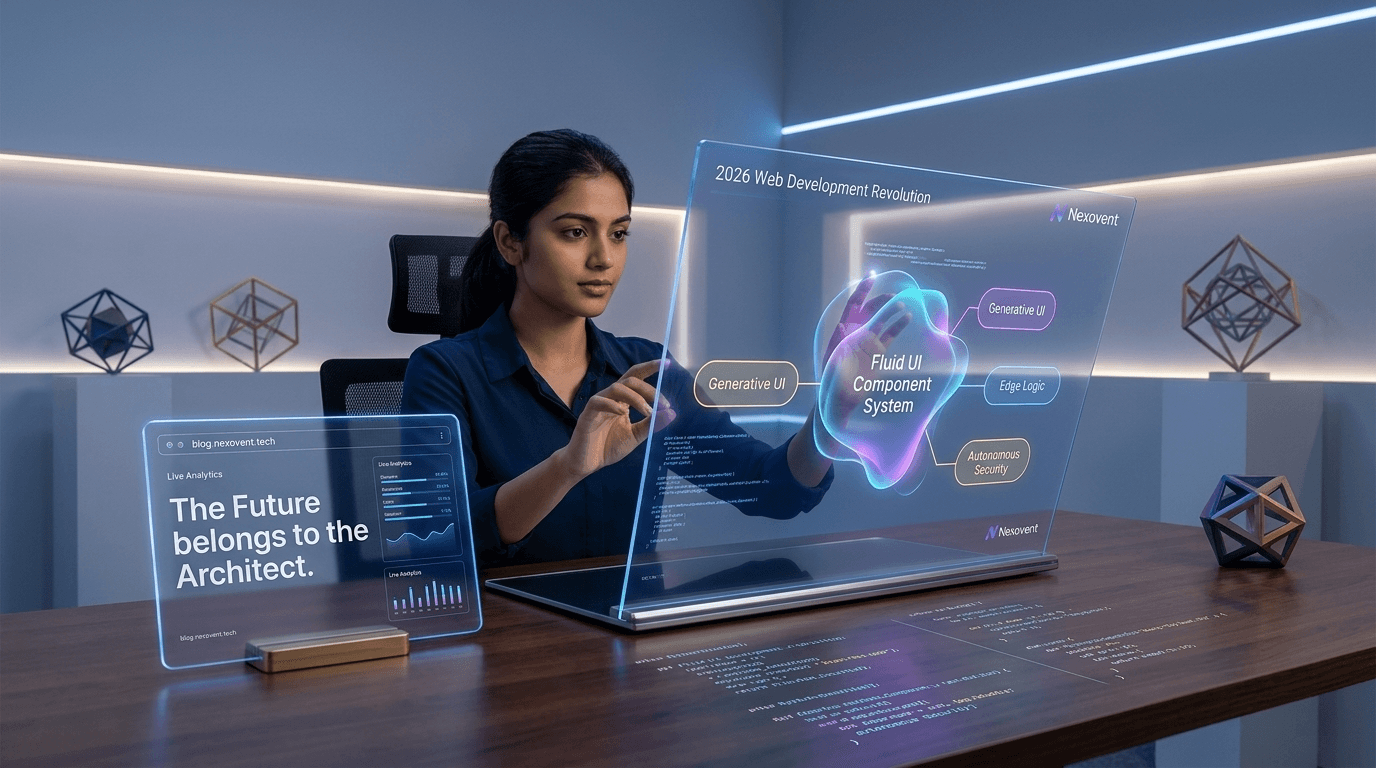
At Nexovent, we emphasize that "User Experience" is now "User Individualization." Developers must now build "Fluid Component Systems" that can be rearranged by an AI engine on the fly. This requires a deep understanding of modular design and state management.
2. The Edge-First Manifesto: Zero Latency as a Standard
In 2026, speed is no longer a luxury—it is a survival requirement. The "Edge-First" approach means that the heavy lifting of the backend has moved from centralized data centers in Virginia or Dublin to the "Edge"—the network nodes physically closest to the user.
The Impact of WebAssembly (Wasm):
WebAssembly has reached its peak. We are now running complex, desktop-grade software—from 3D rendering engines to high-end video editors—directly inside the browser at 99% native speed. This shift has blurred the line between "Desktop Apps" and "Web Apps."
Developer's Task: You are no longer just optimizing images; you are optimizing execution threads. Learning how to leverage Edge Functions and Wasm is the difference between a site that loads and a site that "appears."
3. Autonomous Security and Self-Healing Codebases
The threat landscape of 2026 is terrifyingly fast. AI-driven cyber-attacks can probe for vulnerabilities in milliseconds. To counter this, we have moved into the age of Autonomous Security.
Modern codebases are now "Self-Healing." Using advanced AI agents integrated into our CI/CD pipelines, the system can:
Detect a zero-day vulnerability.
Draft a security patch.
Run tests to ensure the patch doesn't break existing features.
Deploy the fix—all before a human developer even finishes their morning coffee.
Security is no longer a department; it is an automated feature of the code itself.
4. The Semantic Web and Intent-Based Navigation
Search engines have evolved into "Answer Engines." In 2026, users don't "browse" anymore; they "request."
Semantic Optimization:
Your blog or business site must be optimized for semantic understanding. This means your data must be structured so that AI agents can crawl and understand the context of your content, not just the keywords. This is why SEO at Nexovent focuses heavily on Schema Markup and Knowledge Graphs.
5. The "Human-Architect" Model: Why We Still Need You
With all this automation, a common fear is that the developer is becoming obsolete. The reality is quite the opposite. While AI can write a React component or a Python script in seconds, it lacks Strategic Empathy.
AI cannot:
Understand the cultural nuances of a target audience.
Align a technical feature with a long-term business vision.
Solve ethical dilemmas in data privacy.
In 2026, the successful developer is an Architect of Intent. You are the one who guides the AI, sets the guardrails, and ensures that the technology serves a human purpose.
Conclusion: The Road Ahead for Nexovent
The digital frontier of 2026 is bold, fast, and incredibly rewarding for those who are prepared. At Nexovent, we are committed to bridging the gap between raw code and intelligent strategy. The future belongs to the "T-shaped" developer—someone who has deep technical skills in automation but also a broad understanding of the digital economy.
Stop coding for the past. Start architecting for the future.